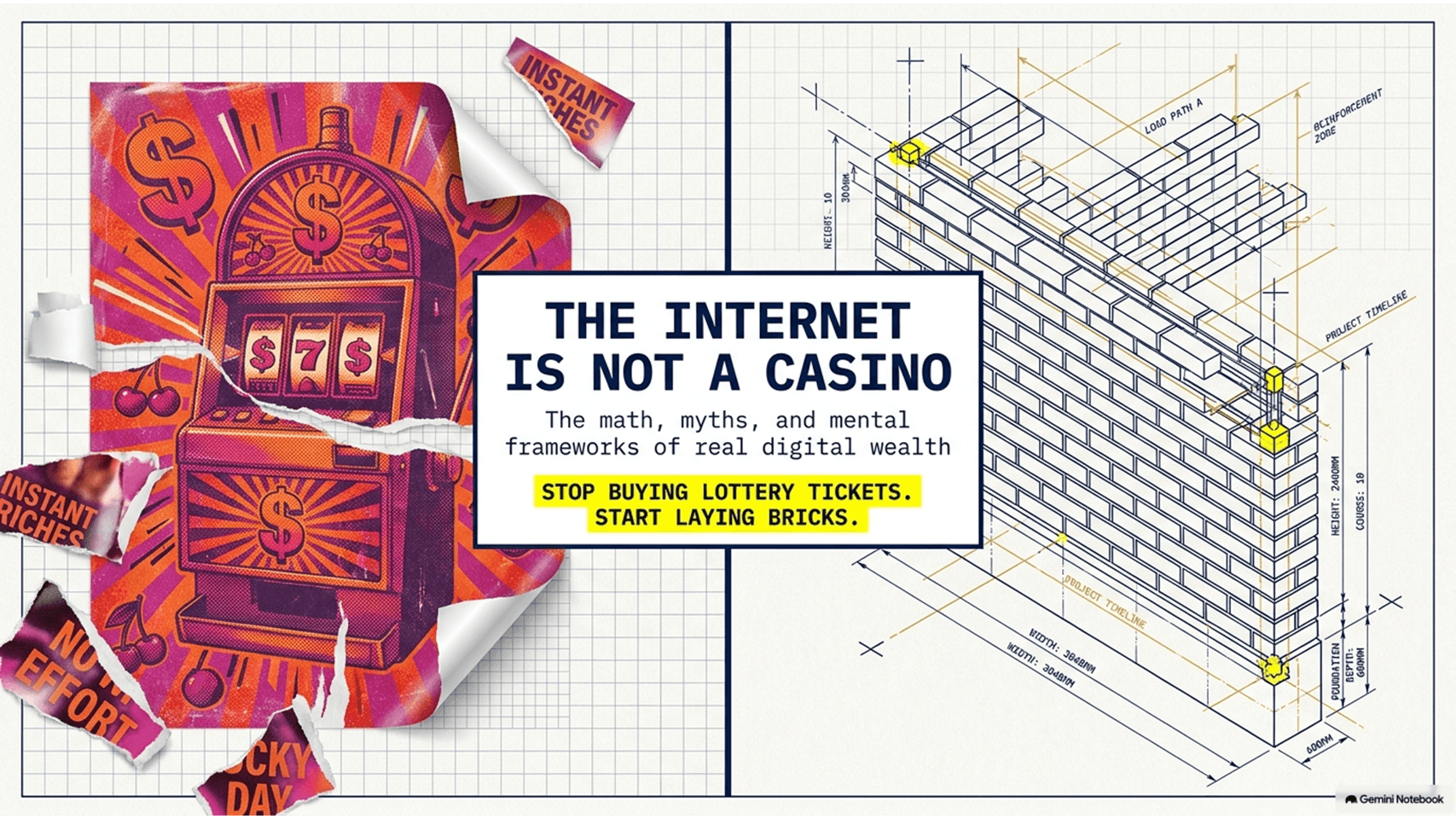
If you take only one thing away from this entire book, let it be this: The internet is not a casino, and wealth is not a lottery ticket.
Every day, thousands of beginner’s log onto YouTube, Instagram, and TikTok and are immediately bombarded by 22-year-olds leaning against rented Lamborghinis, telling them they can make $10,000 by next Tuesday using a "secret loophole."
They are lying to you.
They aren't making $10,000 a week doing the thing they are telling you to do; they are making $10,000 a week selling you the course on how to do the thing. You are not their student; you are their product.
To succeed online, you must completely rewire your brain to understand how digital wealth is actually built. Here is the deep dive into the reality of the timeline, the traps to avoid, and the mental frameworks you need to survive the journey.
The Anatomy of the "Get-Rich-Quick" Illusion
Why is this lie so pervasive? Because human beings are biologically hardwired to seek immediate rewards and avoid pain. Scammers and "gurus" know this. They prey on your financial anxiety, your hatred of your 9-to-5 job, and your desire for freedom.
But let’s look at the math of their claims.
The Revenue vs. Profit Trick
A guru will post a screenshot of their Shopify dashboard showing $100,000 in sales in one week.
What they don't show you: They spent $45,000 on Facebook Ads, $30,000 on inventory and shipping, $10,000 on software and contractors, and had $8,000 in refunds and chargebacks.
The Reality: Their actual take-home profit for that "six-figure week" was about $7,000, and they risked a massive amount of capital to get it. Flashing revenue is easy; generating profit is hard.
The Survivorship Bias Trick
You see the one guy who bought a meme-coin on a Tuesday and became a millionaire on a Friday. What you don't see are the 99,999 other people who bought that same coin on Wednesday and lost their life savings by Thursday. The internet amplifies the anomalies and hides the graveyard of failures.
The Reality: The "J-Curve" of Online Wealth
In a traditional job, your income is linear. You work 1 hour; you get paid for 1 hour. You work 40 hours; you get a paycheck. If you stop working, the money stops immediately.
Online wealth operates on a J-Curve (Exponential Growth). When you build a digital asset (a blog, a YouTube channel, an email list, a software tool, an audience), you are working for free at first. You are laying bricks.
Months 1–6 (The Trench): You work 20 hours a week. You make $0. You feel like an idiot. Your friends think you're crazy.
Months 6–12 (The Traction): You make your first $50. Then $200. The algorithm starts to notice you. Google starts ranking your articles.
Months 12–24 (The Explosion): The compound interest of your past effort kicks in. That article you wrote 10 months ago is now bringing in 5,000 visitors a month on autopilot. Your YouTube back-catalog is generating daily ad revenue. Your income jumps from $200 to $2,000 to $10,000.
The Trap: 95% of people quit in "The Trench" (Months 1-6) because they expect linear results. They put in 40 hours, see $0 in their bank account, declare "this doesn't work," and quit. They never live to see the upward spike of the J-Curve.
Real-World Examples: The "Overnight Success" Myth
To understand this, let’s look at two famous examples of "overnight" internet success.
Example 1: MrBeast (Jimmy Donaldson)
Today, MrBeast is the biggest YouTuber on the planet, making millions per video. People look at his massive sets and think, "He cracked the code." The Reality: Jimmy started making videos in 2012. For four years, he made incredibly boring, low-quality videos (like estimating how many subscribers he had or playing Minecraft) to an audience of almost zero. He obsessed over the algorithm, studied thumbnails, and failed publicly for half a decade before his "viral" breakthrough. His "overnight success" took roughly 2,000 days of grinding in the dark.
Example 2: The "Drop shipping" Millionaire
You see an ad for a 19-year-old claiming he made $1M dropshipping cheap gadgets from China. The Reality: He likely started three different failed stores over the last two years, burning through $20,000 of his parents' money or student loans on Facebook ads testing bad products. He finally found one winning product (e.g., a specific type of posture corrector), scaled it heavily, and made a temporary profit before the market saturated. Now, his only sustainable income is selling a $997 course teaching you how he did it.
Actionable Tips, Tricks, and Mental Frameworks
How do you protect yourself from the get-rich-quick mindset and actually build something that lasts? Use these frameworks.
Tip 1: Adopt the "100-Hour Rule"
Whenever you start a new online venture (learning SEO, starting a newsletter, coding an app), commit to exactly 100 hours of deep, focused work before you are allowed to judge if it is "working."
Why? Because anything new is incredibly difficult at first. Your brain will try to convince you to quit at Hour 12 because it feels too hard.
The Trick: Keep a simple spreadsheet tracking your hours. When you hit Hour 100, look at your data. If it's still not working, pivot. But never quit at Hour 15 just because it feels uncomfortable.
Tip 2: Track "Leading" Indicators, Not "Lagging" Indicators
Lagging Indicators: Bank account balance, number of subscribers, total revenue. These are the results of past actions. Staring at them causes anxiety because you can't control them today.
Leading Indicators: Number of cold emails sent today, words written today, videos filmed today, lines of code written.
The Trick: Build a dashboard that only tracks your daily inputs. If you hit your daily inputs, you win the day. The lagging indicators will take care of themselves over time.
Tip 3: Embrace "The Boring"
Get-rich-quick schemes are exciting. They feel like a heist movie. Real online wealth-building is incredibly boring.
It is writing 50 cold emails to get one freelance client.
It is formatting a spreadsheet of your monthly expenses.
It is fixing a broken plugin on your WordPress site.
It is answering the same customer support question for the 100th time.
The Mindset Shift: If the work feels "boring" and repetitive, you are probably doing it right. Excitement is for gamblers; boredom is for builders.
Tip 4: The "Shiny Object" Detox
The biggest killer of online wealth is "Shiny Object Syndrome."
Month 1: You start an Amazon FBA business. It gets hard.
Month 2: You see a TikTok about AI Automation Agencies. You quit Amazon and start an AI agency. You don't know how to sell, so it fails.
Month 3: You see a video about Crypto Day Trading. You move your money there.
The Result: You are a novice at three different things, instead of an expert at one.
The Fix: Pick ONE model. Write it on a sticky note and put it on your monitor. Put on blinders like a racehorse. You are not allowed to look at other business models for 12 months.
Trick 5: Run the "Guru Scam" Test
Whenever someone pitches you an online opportunity, run it through this mental filter. If they use any of the following words, close the tab immediately:
"Secret" (There are no secrets on the internet, only fundamentals).
"Loophole" (Algorithms update weekly; loopholes close in days).
"Push-button" (If it were push-button, they would hire a $5/hour virtual assistant to push it, not sell it to you).
"Guaranteed" (The FTC literally prohibits guaranteeing income in business opportunities).
"Only 3 spots left!" (Fake scarcity is a manipulation tactic used by desperate marketers).
The Bottom Line
If someone offered you a choice: Option A: I will hand you $10,000 tomorrow, but the IRS will audit you, the platform you used will ban you, and you will have learned zero skills to repeat the process. Option B: You will make $0 for the next six months while you learn copywriting, build an audience, and create a product. In year two, you will make $100,000, you will own the asset, and no one can take it away from you.
Every mature entrepreneur chooses Option B.
The internet rewards patience, resilience, and the willingness to suck at something long enough to get good at it. Stop looking for the shortcut. The shortcut is just doing the work consistently while everyone else is looking for a shortcut.
Roll up your sleeves. We have bricks to lay.